Moroccan Msemen is the crown jewel of the Maghrebi breakfast table, a mesmerizing square flatbread defined by its countless translucent, paper-thin layers and a signature crunch. Whether you know it as Msemen or Rghifa, the goal is always the same: achieving that perfect balance between a soft, chewy interior and an exterior covered in charred golden-brown blisters.
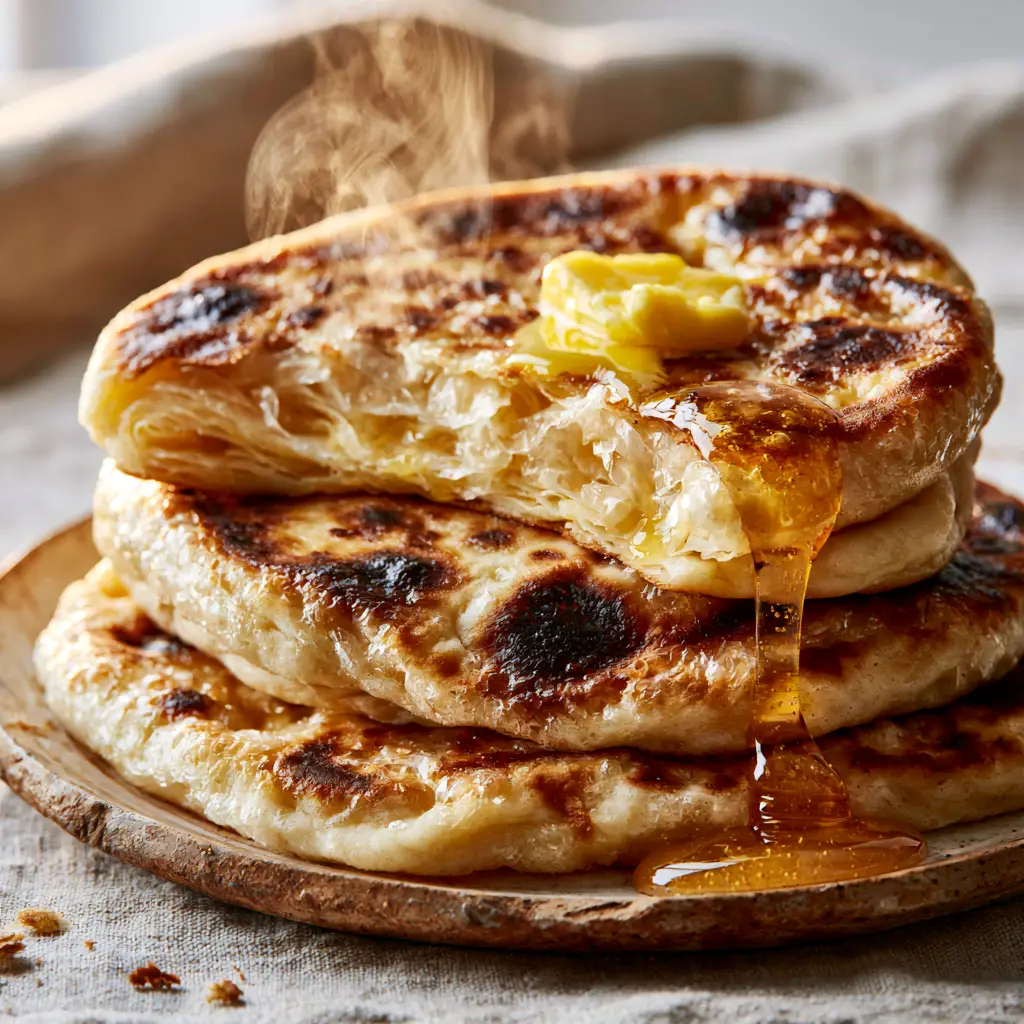
In this guide, we are recreating the exact experience of a bustling Marrakech bakery. Imagine a stack of three warm Moroccan Msemen, the top one partially torn to reveal steaming, buttery folds that catch the morning light. We will top ours with a thick stream of amber honey and a glistening pat of melting salted butter to hit those high-contrast flavor notes.
The Magic Behind This Authentic Moroccan Msemen Recipe
- Visual Perfection: Learn to achieve the deep golden-brown exterior with those specific dark toasted blister marks described in professional food styling.
- Shatteringly Crisp Texture: We use a specific ratio of fine semolina to flour to ensure every bite provides a crystalline, audible crunch.
- Microscopic Crumbs: Our lamination technique creates layers so delicate they practically dissolve, leaving behind those beautiful microscopic crumbs on your linen cloth.
- Steaming Lamination: We focus on the “stretch and fold” method that guarantees dozens of buttery dough layers that release steam the moment they are torn open.
Essential Elements for the Perfect Semolina Dough
Fine Durum Semolina (Smida): This is the backbone of the dough, providing the “toasted” flavor and the structural integrity needed for paper-thin stretching. Use 2 cups (340g) of the finest grind available.
All-Purpose Flour: High-quality unbleached flour adds the necessary gluten elasticity to prevent tearing during the lamination process. You will need 2 cups (250g).
Clarified Butter (Ghee): Unlike regular butter, clarified butter has a higher smoke point, which is critical for achieving those charred blisters without burning the pastry. We use 1/2 cup (115g) for layering.
Neutral Oil: A high-heat oil like vegetable or grapeseed oil is used to coat your hands and the work surface, allowing the dough to glide into a translucent sheet. Have 1/2 cup (120ml) ready.
Salt and Sugar: 1 tsp (6g) of fine sea salt enhances the grain, while 1 tsp (4g) of granulated sugar aids in the rapid browning of the crust.
Warm Water: You will need approximately 1.5 cups (355ml) of warm water (105°F/40°C) to hydrate the semolina properly for a supple, workable dough.
Tools for Mastering the Art of Rghifa
To achieve the results seen in professional food photography, you need a heavy-bottomed cast iron skillet or a traditional Moroccan farrah. The heavy thermal mass is what creates those specific dark toasted blister marks while keeping the center soft.
A large, smooth marble or stainless steel work surface is also vital. You need enough space to stretch the Moroccan Msemen dough until it is virtually transparent before the folding sequence begins.
Step-by-Step Lamination: From Ball to Flaky Square
1. Kneading for Elasticity
Combine the semolina, flour, salt, and sugar in a large bowl. Gradually add the warm water and knead for at least 10 minutes by hand or 6 minutes in a stand mixer. You are looking for a dough that is smooth, slightly tacky, but extremely elastic.
2. The Resting Phase
Divide the dough into smooth, golf-ball-sized spheres. Lightly coat each with oil and place on a tray. Cover with plastic wrap and let them rest for 30–45 minutes; this “relaxes” the gluten, which is the secret to stretching the dough paper-thin without it snapping back.

3. Achieving the Translucent Stretch
Generously oil your work surface. Take one ball and flatten it with the palm of your hand, spreading it outward in a circular motion. Use your fingers to gently pull the edges until you have a massive, translucent sheet where you can see the grain of the table beneath it.
4. The Lamination Fold
Brush the transparent sheet with melted clarified butter and sprinkle a pinch of dry semolina over the surface—this acts as a barrier to keep the layers separate. Fold the top third down to the center, then the bottom third up, creating a long rectangle. Repeat with the sides to form a neat square “envelope.”
Achieving Those Signature Charred Golden-Brown Blisters
Heat your skillet over medium-high heat until a drop of water sizzles instantly. Lightly oil the pan. Take one dough square and gently pat it out to flatten it further, increasing its size by about 20%.
Place the square onto the hot surface. Cook for about 2 minutes, then flip. The Moroccan Msemen should begin to puff up with steam, separating the internal layers. Flip frequently until the exterior is a deep golden-brown with those coveted dark toasted blister marks and a crystalline, shatteringly crisp texture.
Pro-Level Secrets for Paper-Thin Layers
- The Semolina Barrier: Never skip the light dusting of semolina between the folds; it is the “invisible” ingredient that prevents the layers from fusing back into a solid block of dough.
- Temperature Control: If the pan is too cool, the bread will be tough and oily; if it is too hot, it will burn before the interior layers cook through. Look for active steam escaping the sides.
- Salted Butter Finish: Always place a small pat of cold salted butter on the stack immediately after cooking so it creates that glistening, liquid yellow pool.
How to Store and Reheat Your Laminated Crepes
Moroccan Msemen is best served immediately while the layers are at their peak “shatter” state. However, you can store them in an airtight container for up to 2 days.
To reheat, avoid the microwave as it makes the pastry rubbery. Instead, place them back in a dry skillet over medium heat for 1 minute per side until the exterior crispness returns and the butter inside begins to sizzle again.
Traditional Pairings: What to Serve with Moroccan Msemen
For a full Moroccan breakfast spread, serve these flatbreads alongside a smoky zaalouk for a savory twist or a warm bowl of harira during colder months. If you are serving them as a snack, they pair beautifully with crispy chicken briouats for a multi-textured appetizer course.
Frequently Asked Questions
You can, but the milk solids in regular butter will burn at the high temperatures needed to get those dark toasted blisters. Clarified butter (ghee) provides a cleaner, toasted flavor and a crispier finish.
Yes! You can freeze them after they are cooked and cooled. Place parchment paper between each flatbread, wrap in foil, and freeze for up to 3 months. Reheat in a skillet directly from frozen.
While both use similar semolina dough, Msemen is folded into a square, whereas Meloui is rolled into a circular coil before flattening, resulting in a different layer orientation.
Puffing is caused by steam trapped between layers. If your layers are too thick or if you didn’t use enough butter and semolina between the folds, the layers will fuse together and prevent the puff.
Toughness usually comes from under-hydrating the semolina or overworking the dough without enough resting time. Ensure you let the dough balls rest for at least 30-45 minutes to allow the gluten to relax.
The Official Moroccan Msemen Recipe Card
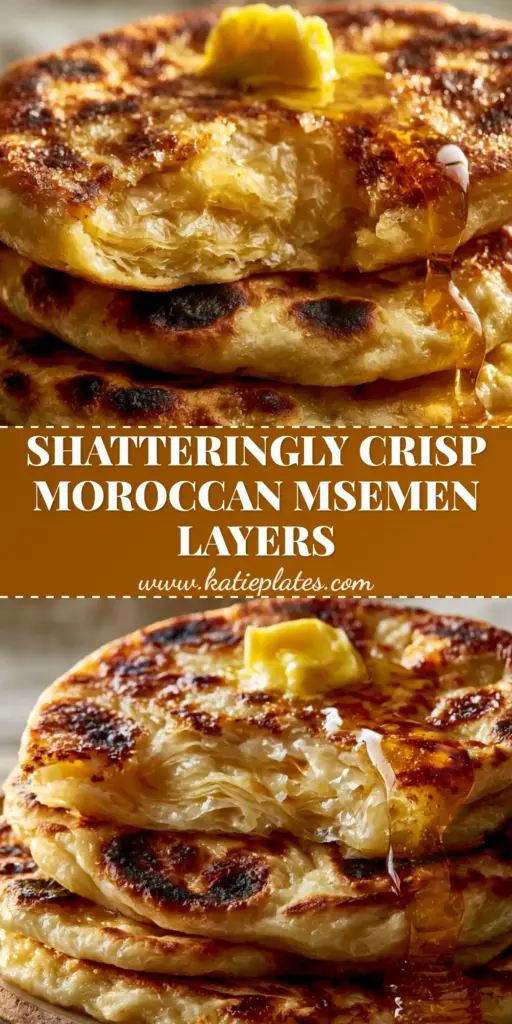
Moroccan Msemen: The Ultimate Guide to Shatteringly Crisp Laminated Flatbread
Ingredients
Equipment
Method
- Combine semolina, flour, salt, and sugar. Gradually add warm water while kneading for 10 minutes until the dough is elastic and smooth.
- Divide dough into 8 balls, coat with oil, and let rest covered for 45 minutes to relax the gluten.
- Oil your surface and hands. Flatten one ball and pull the edges until it is a translucent, paper-thin sheet.
- Brush with clarified butter and sprinkle semolina. Fold into thirds both ways to form a square envelope.
- Flatten the square slightly. Cook on a hot skillet for 2 minutes per side until charred golden-brown blisters form and layers puff.
- Stack warm Msemen and top with a pat of salted butter and a drizzle of honey while steaming.
Notes
Use clarified butter (ghee) for the best toasted flavor and higher smoke point.
Bring the Flavors of Morocco to Your Kitchen
Mastering Moroccan Msemen is a rite of passage for any home cook interested in the science of laminated doughs. The contrast between the amber honey drizzle and the salty, toasted dough is a sensory experience unlike any other. If you enjoyed this deep dive into Moroccan pastry, please leave a comment below and share your results on Pinterest!